Most people are watching the newest AI models evolve.
State education leaders are writing the rules that will determine whether those models can actually be used.
Over the past few weeks, a pattern has emerged.
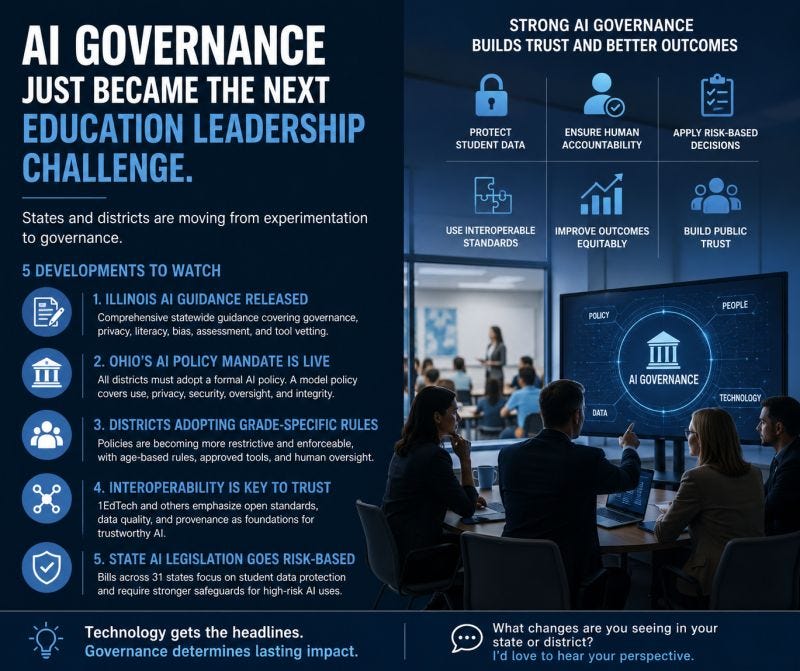
Illinois published one of the most comprehensive AI guidance documents I've seen. Ohio now requires every district to adopt an AI policy. Districts are moving beyond "AI is allowed" toward age-specific rules, approved tool lists, human oversight, and documented governance.
That tells me something important.
We're leaving the experimentation phase.
We're entering the governance phase.
The conversation is also shifting beyond AI itself.
Interoperability standards, data quality, identity management, procurement, and privacy are becoming AI problems because AI is only as trustworthy as the data and controls surrounding it.
I've spent much of my career helping education organizations make better decisions with data. The pattern feels familiar.
Every major technology wave eventually becomes a governance challenge.
Cloud computing did.
Student data systems did.
AI is following the same path.
The districts that succeed won't necessarily have the most advanced AI. They'll have the clearest decision-making framework for when AI should be used, what data it can access, who is accountable, and how outcomes are monitored.
Technology gets the headlines.
Governance determines whether the technology delivers lasting value.
What changes are you seeing in your state or district? Are AI discussions still centered on classroom use, or have they expanded into enterprise governance?